
most businesses try SEO the same way. They publish a few blog posts, tweak some meta tags, maybe do a bit of keyword research, and then wait. Weeks pass. Rankings don’t move. Traffic flatlines. And the common conclusion? “SEO just doesn’t work for us.”
But here’s the thing: SEO does work. What doesn’t work is doing it randomly. That’s exactly why businesses need an SEO workflow a clear, repeatable system that takes every piece of content from idea to ranking, without chaos in between.
In this guide, we’ll break down what an SEO workflow actually looks like, why it’s a non-negotiable for any business serious about organic growth, and how to build one from scratch even if you’re starting with a small team.
What Is an SEO Workflow? (And Why Most Businesses Don’t Have One)
An SEO workflow is a step-by-step process that guides your content from keyword research all the way through to publishing, tracking, and optimization. Think of it like an assembly line — every station has a job, every person knows their role, and nothing falls through the cracks.
Without a workflow, SEO becomes reactive. You write content when you feel like it, optimize when you remember to, and check rankings when panic sets in. That’s not a strategy — it’s guesswork with extra steps.
A proper SEO workflow flips this. It gives your team a shared playbook so that every piece of content has the best possible chance of ranking — before it ever goes live.
Why Businesses Need an SEO Workflow — The Real Reasons
There are plenty of articles that’ll tell you SEO is important. But fewer explain why the workflow behind it matters just as much as the tactics themselves. Here’s the truth: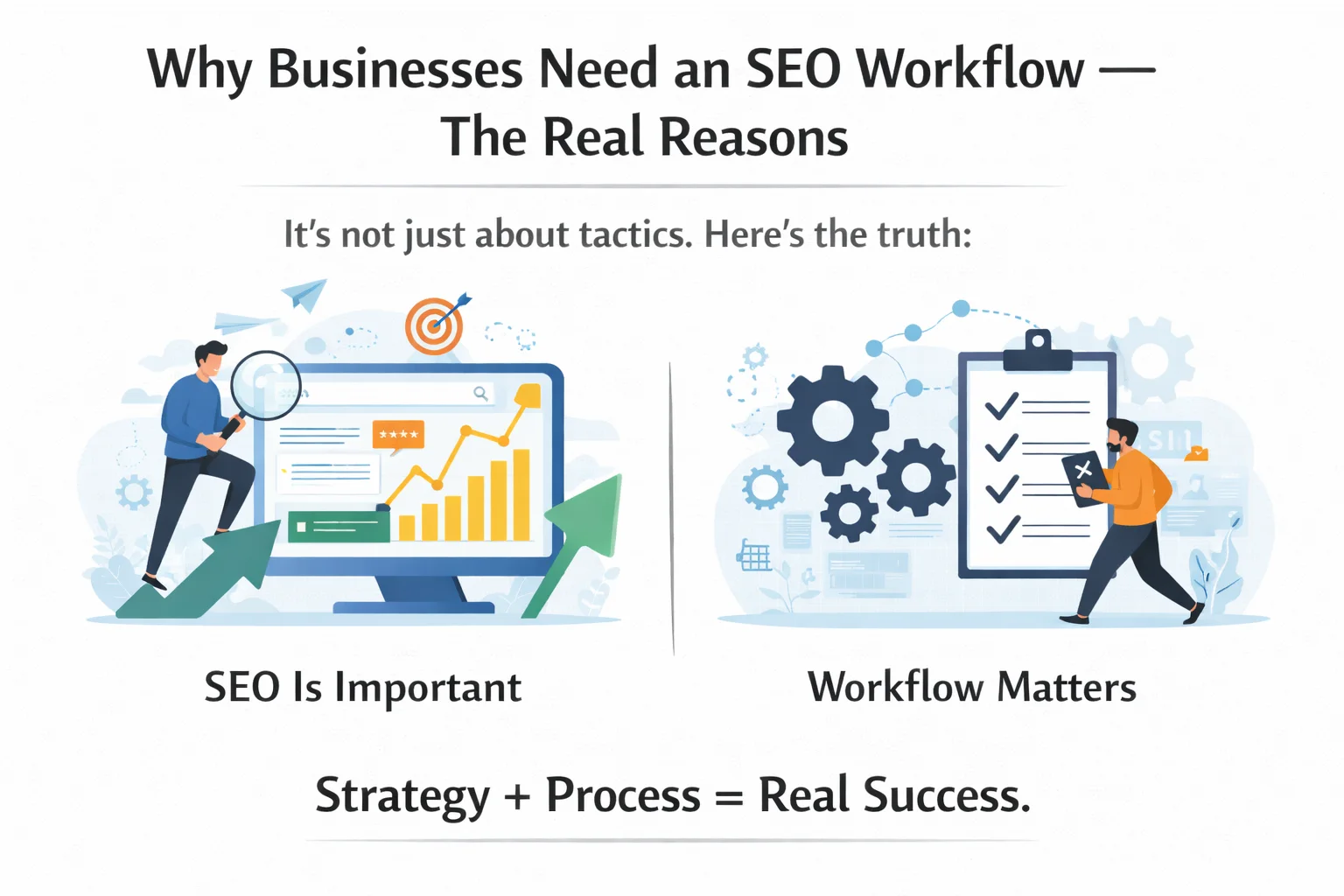
1. It Makes SEO Repeatable
One of the biggest silent killers of SEO results is inconsistency. When there’s no workflow, every piece of content gets a different level of effort. Some get properly researched and optimized. Others get rushed out the door. A workflow levels the playing field — every piece goes through the same process, every time.
2. It Saves Enormous Amounts of Time
Teams with a defined SEO workflow publish faster. Not because they cut corners — because they don’t waste time figuring out what to do next. When the process is clear, execution is swift. A writer knows exactly what brief to follow. An editor knows exactly what to check. A developer knows exactly when to step in.
3. It Aligns Your Entire Team
SEO isn’t a one-person job. It touches writers, designers, developers, and strategists. Without a shared workflow, everyone interprets “good SEO” differently. With one, there’s no confusion about who does what, or when. Everyone pulls in the same direction.
4. It Keeps Quality Consistent
When quality depends on individual memory, quality varies. When it’s baked into a checklist, it’s consistent. A good SEO workflow includes quality gates — points in the process where content gets reviewed before moving forward. That’s how you prevent thin content, missing meta tags, and broken internal links from slipping through.
5. It Turns SEO Into a Revenue Engine
Here’s the big picture: structured execution is what connects search visibility to actual business outcomes. When your workflow is tight, your content ranks. When it ranks, it drives traffic. When that traffic is well-targeted, it converts. That’s not magic — it’s a process working as designed.
The 5 Core Stages of a Business SEO Workflow
Every effective SEO workflow — regardless of business size or industry — runs through these five stages. The details might vary, but the structure stays the same.
1 Keyword & Topic Research
This is where it all begins. You identify what your audience is actually searching for, map those terms to stages of the buyer journey (awareness, consideration, decision), and prioritize by business value — not just search volume. A 300-search keyword with high purchase intent can be worth ten times a 5,000-volume keyword with zero conversion potential.
Stag 2 Content Planning & Brief Creation
Once you have a keyword, you need a plan. A content brief translates keyword data and search intent into a concrete writing guide — what the article should cover, the ideal structure, target word count, internal linking opportunities, and any competitor gaps worth addressing. Good briefs make good content. Great briefs make content that ranks.
3 Content Creation & On-Page SEO
This is where writing happens — but it’s also where on-page optimization gets built in from the start, not added as an afterthought. That means using the focused keyword naturally in the title, intro, H2s, and meta description. It means logical heading structure, internal links to relevant content, image alt text, and schema markup where applicable.
4 Technical Review & Publishing
Before anything goes live, it should pass a technical check. Page speed, mobile responsiveness, canonical tags, URL structure, and redirect health all matter. This stage is often skipped in ad-hoc SEO — and it’s often the reason good content fails to rank despite solid writing.
5 Performance Tracking & Content Refresh
Publishing is not the finish line. The best SEO teams monitor rankings and organic traffic through tools like Google Search Console and GA4, then revisit underperforming content on a regular refresh cycle. Updating old articles with new data, better targeting, and improved structure can sometimes triple your traffic without writing a single new word.
What Happens When Businesses Skip an SEO Workflow
Skipping a workflow doesn’t just slow you down — it actively costs you. Here’s what tends to go wrong when SEO is handled without structure: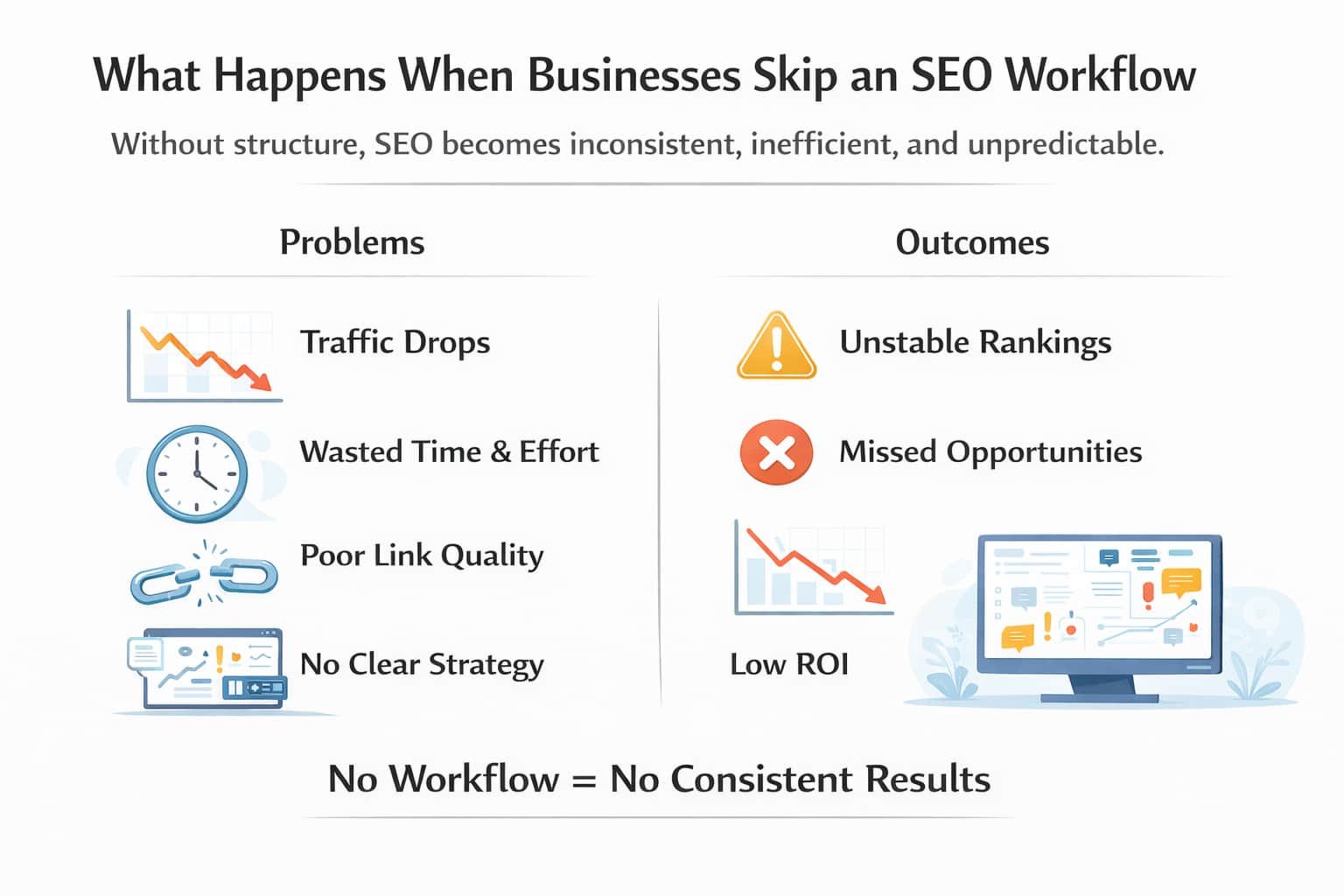
- Missing on-page elements — no meta descriptions, poor heading hierarchy, zero internal links. These are basic wins left on the table.
- Inconsistent publishing — sporadic content signals to Google that your site isn’t active or authoritative.
- Team confusion — when everyone does SEO differently, nothing gets done well.
- Wasted content budget — articles that aren’t optimized from the start rarely rank, regardless of how well they’re written.
- No performance loop — without tracking and refreshing, even your best content slowly decays in rankings as competitors update theirs.
How to Build Your First SEO Workflow (Step-by-Step)
You don’t need a big team or a big budget to start. You need clarity and commitment to a process. Here’s how to build yours:
- Define your goals — what does success look like? More organic traffic? Higher lead quality? Lower cost per acquisition? Your workflow should be designed around a specific outcome.
- Assign clear roles — who handles strategy, who writes, who handles technical SEO, and who tracks performance? Document it.
- Choose your tools — Ahrefs or Semrush for keyword research, Notion or Asana for task management, Google Search Console and GA4 for tracking. Pick tools your team will actually use.
- Create templates — a content brief template, a pre-publish SEO checklist, and a content refresh framework are the three must-haves.
- Start small, then scale — build the workflow around one content type (e.g., blog posts) first. Once that’s running smoothly, expand to landing pages, product pages, and beyond.
SEO Workflow Tips That Actually Move the Needle
Once your workflow is up and running, these principles will help you get more out of it:
- Prioritize keyword intent over keyword volume. A 200-search keyword from someone ready to buy is worth more than a 5,000-volume keyword from someone just browsing.
- Build in a content refresh cycle. Set a calendar reminder to review your top 20 pages every quarter. Small updates — new stats, better headings, fresh internal links — can meaningfully lift rankings.
- Treat technical SEO as part of the workflow, not a separate project. Build your technical checklist into the pre-publish stage so it gets done every time.
- Consistency beats volume. Publishing two well-optimized pieces per week, week after week, will outperform a content sprint of 20 rushed articles every time.
- Track what matters. Focus on organic traffic growth, keyword position changes, and conversions from organic — not vanity metrics like page views in isolation.
Ready to build your SEO workflow? Book a free SEO audit with our team and we’ll map out a workflow tailored to your business goals.
Frequently Asked Questions (FAQs)
What is an SEO workflow?
A step-by-step process that takes content from keyword research to publishing and tracking — ensuring nothing gets skipped along the way.
Why do businesses need an SEO workflow?
Without one, SEO is inconsistent and reactive. A workflow makes it repeatable, saves time, aligns your team, and ties organic search directly to business results.
How long before an SEO workflow shows results?
Typically 3 to 6 months. A structured workflow speeds this up by ensuring every piece is fully optimized from the start — reducing wasted effort and compounding gains faster.
Can small businesses use an SEO workflow?
Yes. Even a solo marketer can build a simple checklist-based workflow. Consistency with a small workflow beats sporadic bursts of unstructured SEO every time.
What tools do I need?
Start with Ahrefs or Semrush for research, Notion or Asana for task management, and Google Search Console + GA4 for tracking. Add more tools as your workflow scales.
Is technical SEO part of the workflow?
Absolutely — it should be built into the pre-publish stage, not treated as a separate project. Page speed, mobile-friendliness, and structured data all matter before you hit publish.
Conclusion
SEO is not a one-time task — it is an ongoing process. And like any process, it only delivers consistent results when it is structured, documented, and followed through. That is exactly why businesses need an SEO workflow.
Whether you are a solo founder publishing your first blog post or a marketing team managing hundreds of pages, a workflow gives your SEO the backbone it needs to actually perform. It removes guesswork, closes gaps, and turns your content efforts into a compounding growth engine over time.
The best time to build your SEO workflow was yesterday. The second best time is right now. Start simple, stay consistent, and let the process do the work.