you have been building backlinks for months, and your rankings are actually going down. Frustrating, right? You are not alone. Thousands of website owners make the same mistake every day, pouring time and money into links that do more harm than good.
Here is the truth that most beginners miss: not all backlinks are created equal. The difference between high-quality backlinks vs toxc links is the difference between climbing the rankings and getting penalized by Google. One type earns trust, drives real traffic, and signals authority. The other quietly destroys everything you have worked for.
In this guide, you will learn exactly what separates a great backlink from a dangerous one, how to spot toxic links before they cause damage, and how to build the kind of link profile that Google genuinely rewards. No jargon, no fluff, just practical SEO you can actually use.
What Are Backlinks and Why Do They Matter?
A backlink is simply a link from one website to another. When Website A links to your content, that is a backlink pointing to you. Think of it like a vote of confidence in the digital world, one website saying to Google: “This content is worth reading.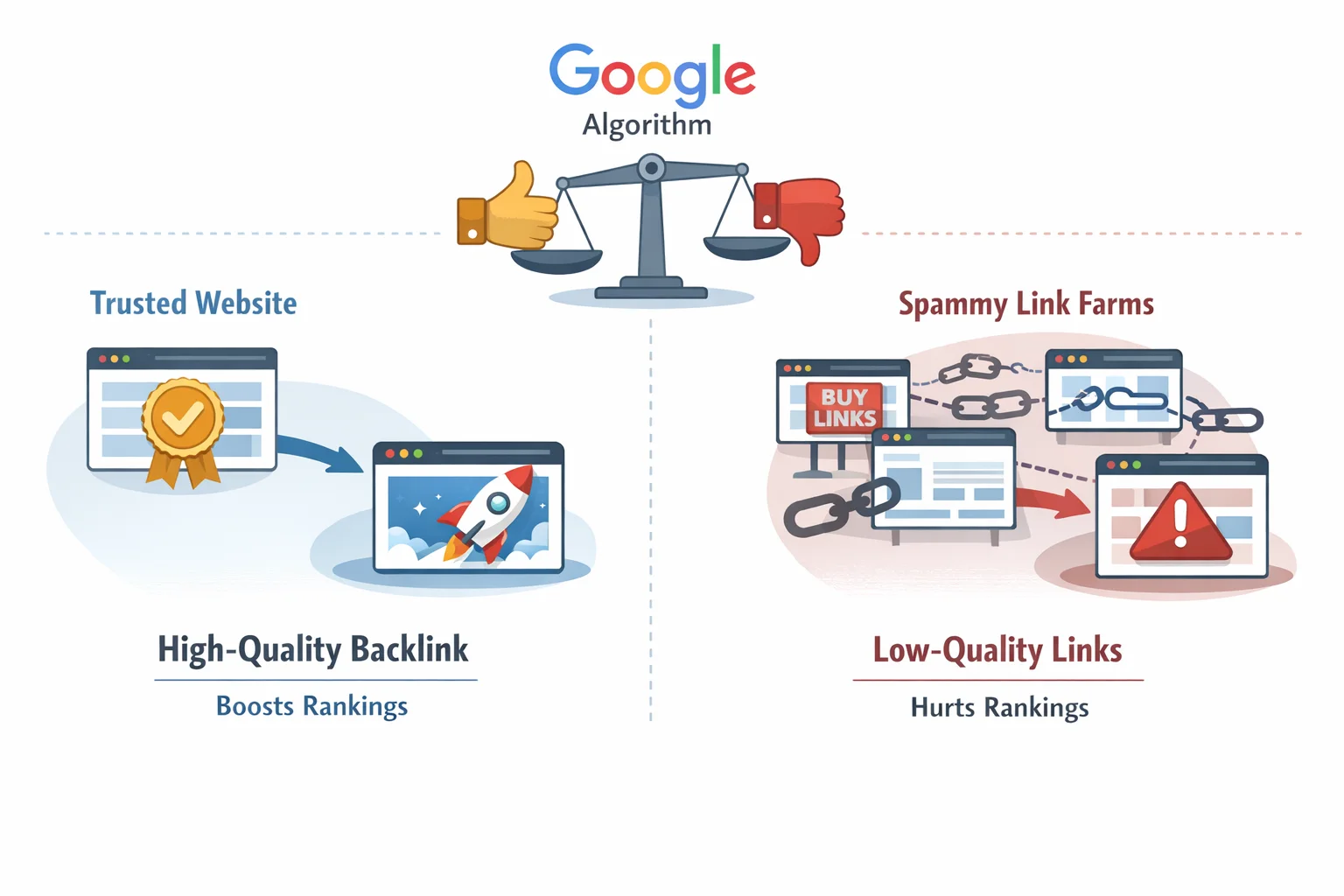
Google’s algorithm has always treated backlinks as a core ranking signal. The logic is straightforward: if lots of reputable, relevant websites are linking to your page, it must be good. The more credible the sources vouching for you, the higher Google tends to rank your content.
But here is where things get interesting. In the early days of SEO, quantity ruled everything. More links meant higher rankings, full stop. Website owners exploited this by building thousands of low-quality links through link farms, comment spam, and paid schemes. Google caught on.
one high-quality backlink from a trusted, relevant site is worth more than a thousand links from spammy directories. Google has become incredibly good at distinguishing between links that represent genuine editorial endorsements and links that were manufactured to game the system. The ones it does not like? Those can actively hurt you.
What Makes a Backlink High-Quality?
Not every link is worth chasing. A high-quality backlink shares a specific set of characteristics that make Google trust it. Here is what you should be looking for:
1. Relevance to Your Niche
A link from a website in your industry carries far more weight than a random one. If you run a fitness blog and a respected nutrition website links to your article, that connection makes sense to Google. If a car dealership or a casino website links to you, it raises red flags. Relevance signals that the endorsement is genuine, not manufactured.
2. Domain Authority and Domain Rating
Domain Authority (Moz) and Domain Rating (Ahrefs) are third-party metrics that estimate how trusted a website is. Sites with scores above 50 are generally considered strong. A single link from a high-DA publication like Forbes, HubSpot, or a well-established industry blog can outweigh dozens of links from smaller, unknown sites.
3. Real Traffic on the Linking Page
A link from a page that actually gets visitors does two things: it tells Google the page is valued by real people, and it can send actual referral traffic to your site. Links from pages that nobody reads offer far less value even if the domain itself scores well.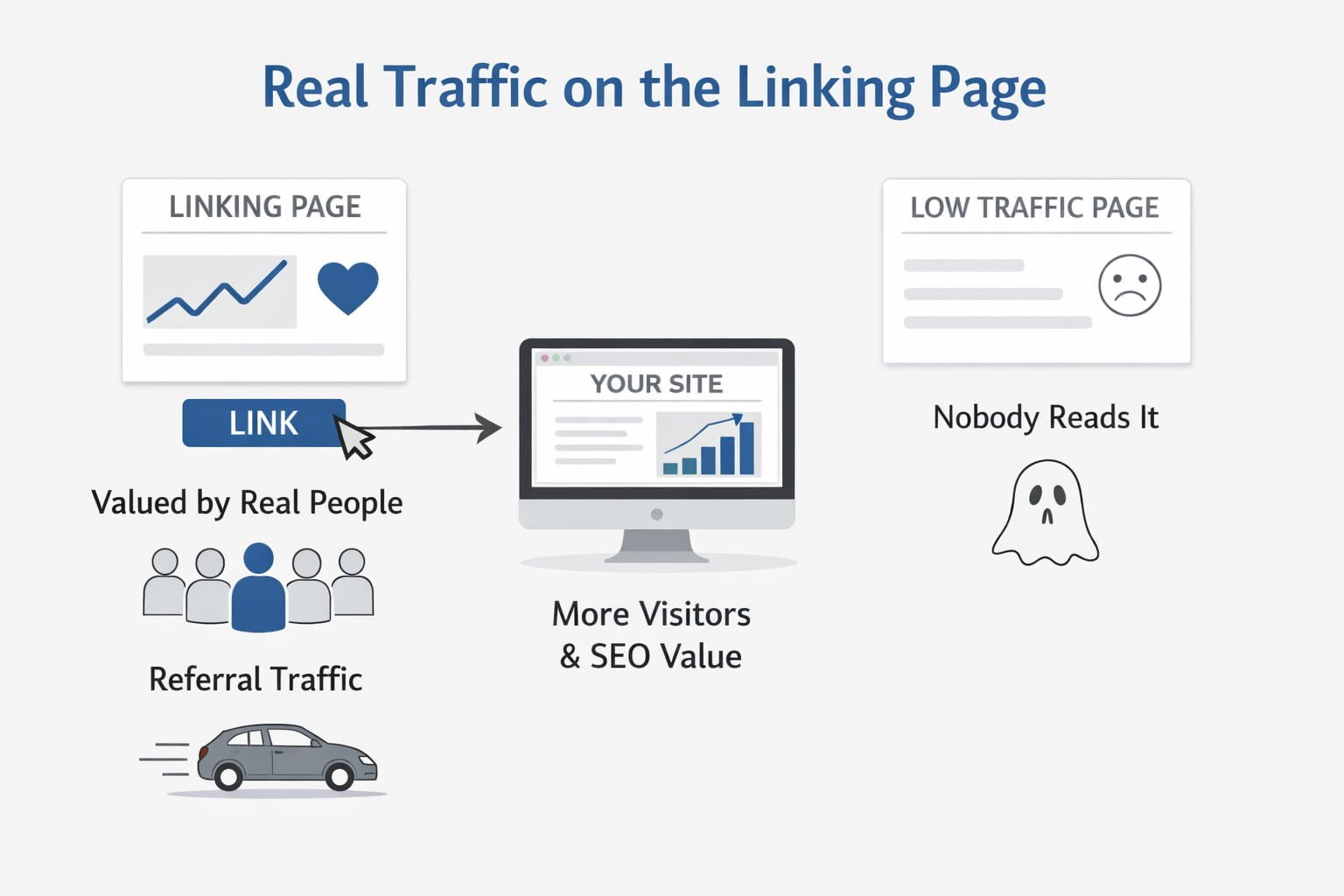
4. Natural Anchor Text
Anchor text is the clickable words used in the link. Healthy link profiles have a natural variety: branded anchors (your company name), generic anchors (click here, learn more), and occasionally topical anchors. When too many links use the exact same keyword-rich phrase, Google treats it as a manipulation signal.
5. Editorial Placement
The best backlinks are placed organically within the body of an article because the author genuinely found your content useful. Links buried in footers, crammed into sidebars, or placed in author bio boxes carry significantly less authority than in-content editorial links.
6. The Linking Site’s Own Trustworthiness
Links from government domains (.gov), educational institutions (.edu), major news outlets, and well-established industry publications sit at the top of the backlink value pyramid. These sites have earned enormous trust over years, and when they point to you, some of that trust transfers.
What Are Toxic Links and Where Do They Come From?
If high-quality backlinks are the fuel that powers your SEO, toxic links are the sand in the engine. Toxic links are backlinks from low-quality, spammy, manipulative, or irrelevant sources that either do nothing for your rankings or actively harm them.
Here is where toxic links typically come from:
Link Farms
Link farms are networks of websites built for one purpose only: to generate and sell backlinks. They have no real content, no real audience, and no editorial standards. Google identified and devalued these long ago, but they still float around causing damage.
Private Blog Networks (PBNs)
PBNs are networks of fake or expired domains that a single person controls, used to funnel link authority to a money site. It sounds clever in theory, but Google has become extremely skilled at identifying PBN patterns. Sites caught using them face severe ranking drops.
Comment and Forum Spam
Dropping links in blog comments, forum threads, or Q and A sites with no real context used to work in the early 2000s. Now it is one of the clearest spam signals in Google’s book, especially when done at scale.
Spammy Directories
There are legitimate directories out there, like Yelp or industry-specific listings. But the thousands of low-quality, “submit your link” directories that accept everything? These are almost always toxic territory.
Paid Link Schemes
Buying links, or accepting payment for placing links, is a direct violation of Google’s Webmaster Guidelines. This applies whether you are the buyer or the seller. Google’s quality team actively monitors for these patterns, and getting caught means a manual penalty.
AI-Generated Link Spam
A newer and growing threat: automated tools that churn out hundreds of low-quality blog posts loaded with outbound links. These are designed to pass link authority cheaply and at scale. Google’s spam algorithms are increasingly effective at neutralizing them, but they can still create noise in your backlink profile.
Penalized or Deindexed Domains
A link from a site that Google has already deindexed or manually penalized is worth nothing, and depending on the volume, could pull you down with it. Checking the health of your linking domains is an important part of any backlink audit.
High-Quality Backlinks vs Toxic Links: Side-by-Side Comparison
Here is a clear breakdown of how these two types of links differ across every dimension that matters to your SEO:
| Feature | High-Quality Backlink | Toxic Link |
|---|---|---|
| Source authority | High DA/DR, trusted site | Low DA, spammy domain |
| Relevance | Same niche or closely related | Unrelated or random |
| Anchor text | Natural, varied, contextual | Over-optimized, exact-match spam |
| Placement | Editorial, within content | Footer, sidebar, paid widget |
| Traffic on linking page | Real visitors, engaged audience | Little to no real traffic |
| Effect on rankings | Positive — boosts authority | Negative or neutral at best |
| Google’s response | Rewards with higher rankings | Ignores or penalizes |
The simplest way to think about it: high-quality backlinks are earned through great content and real relationships. Toxic links are manufactured shortcuts. Google rewards the first and increasingly ignores or punishes the second. In the long run, there is no substitute for genuine authority.
How Toxic Links Actually Harm Your SEO
Some people assume that bad links simply do nothing. The reality is more serious than that. Here is how toxic links can damage your website:
Algorithmic Penalties
Google’s Penguin filter runs continuously. If your link profile triggers its spam detection thresholds, your rankings can drop quietly and suddenly without any notification from Google. There is no warning, no appeal window, just a drop in organic traffic that can be difficult to trace back to its source.
Manual Actions
Google’s web spam team manually reviews sites suspected of serious violations. If they issue a manual action against your site for unnatural links, you will see a notification in Google Search Console. The consequences range from ranking demotion to complete deindexing from search results. Recovery requires disavowing the links and submitting a reconsideration request, which can take months.
Negative SEO Attacks
Here is an uncomfortable reality: competitors can deliberately point toxic links at your website to trigger a penalty. This is called a Negative SEO attack. It is relatively rare, but it happens, particularly in competitive industries. Regular backlink monitoring is your best defense against it.
Damaged Brand Reputation
Search engines are not the only ones who notice your link profile. Being associated with spammy, low-quality sites can affect how your brand is perceived by users who stumble across those pages, and by potential link partners who check your profile before collaborating with you.
How to Identify Toxic Links in Your Backlink Profile
The first step to cleaning up your link profile is knowing what you are dealing with. Here is a practical process for identifying toxic backlinks:
Step 1: Run a Backlink Audit with SEO Tools
Tools like Ahrefs (Site Explorer), SEMrush (Backlink Audit), and Moz (Link Explorer) all offer built-in spam or toxicity scoring. Run a full audit and export your backlink data. These tools flag links based on signals like domain spam score, unnatural anchor text distribution, and the reputation of the linking domain.
Step 2: Look for These Red Flags
- High spam score on the linking domain (above 30 in Moz, above 70 toxicity score in SEMrush)
- Linking sites with irrelevant or unrelated content to your niche
- Excessive use of exact-match keyword anchors pointing to the same page
- Links from foreign-language sites with no logical connection to your business
- Domains that are penalized, deindexed, or show thin AI-generated content
- Links from known link farms, PBN footprints, or expired domain networks
Step 3: Manual Review Before Acting
This step matters. Automated tools are helpful for flagging candidates, but they are not perfect. A link that scores poorly might still be a legitimate mention from a small but genuine site. Before you take any action, manually visit the linking page and ask yourself: does this look like a real website with real content and a real audience? If yes, leave it alone.
Step 4: Watch for Sudden Link Spikes
Set up regular monitoring alerts in your SEO tool of choice. A gradual increase in backlinks is healthy growth. A sudden flood of new links, especially all arriving within days from sites you have never heard of, is a warning sign worth investigating immediately.
How to Remove or Disavow Toxic Links
Once you have identified the links you want to deal with, you have two options: outreach removal and disavowal. Here is how both work:
Option 1: Request Removal Directly
Contact the webmaster of the linking site and politely ask them to remove the link. Keep the email brief and professional. You do not need to explain your entire SEO strategy. A simple message explaining that the link is not a good fit and asking for removal is usually enough. Track your outreach in a spreadsheet and follow up once after a week if you do not hear back.
Option 2: Use Google’s Disavow Tool
If outreach fails or the linking site has no contact information, use the Disavow Tool in Google Search Console. This tells Google to ignore specific links when assessing your site. To use it, create a plain text file listing the URLs or domains you want disavowed, formatted exactly as Google requires, and upload it through Search Console.
A Critical Caution About Disavowing
The Disavow Tool is powerful, and using it incorrectly can hurt more than help. Disavowing legitimate links can strip away authority you have earned. Use this tool only for links you are genuinely confident are manipulative or harmful. For low-quality links that are simply irrelevant, Google’s algorithm is now sophisticated enough to ignore most of them on its own.
How to Build High-Quality Backlinks Naturally
The best way to handle the high-quality backlinks vs toxic links problem is to never rely on shortcuts in the first place. Here are the link-building strategies that actually work in today’s SEO landscape:
Create Genuinely Link-Worthy Content
Original research, comprehensive how-to guides, unique data studies, free tools, and interactive content naturally attract backlinks without you having to ask. When you publish something that is genuinely better than everything else on that topic, people link to it because they want to, not because you asked them to.
Guest Posting on Reputable Sites
Writing high-quality articles for respected publications in your niche remains one of the most effective link-building tactics available. The key word is reputable. Write for sites that have real readership, editorial standards, and a domain authority that makes the link worth having. Avoid mass guest posting to any site that will accept you.
HARO and Journalist Outreach
HARO (Help a Reporter Out) and similar platforms like Qwoted or SourceBottle connect journalists with expert sources. Responding to relevant queries can earn you mentions and backlinks from major publications, including national newspapers, magazines, and high-authority industry sites. These are some of the most valuable links you can earn.
Broken Link Building
Find authoritative pages in your niche that link to resources that no longer exist (broken links). Reach out to the site owner, let them know about the broken link, and suggest your content as a replacement. It is a win for them (fixing a dead link on their site) and a win for you (earning a new backlink).
Digital PR
Create data-driven stories, original surveys, or interesting takes on industry trends and pitch them to journalists and bloggers. When your content gets picked up and cited in an article, you earn a high-quality editorial backlink without any direct link-building effort. This scales well for brands willing to invest in original research.
Build Real Relationships in Your Industry
Collaborate with other content creators, participate in podcasts, speak at industry events, and engage genuinely with other experts in your space. Real relationships lead to natural link opportunities over time, and those links are the most sustainable kind because they are based on mutual trust and value.
Frequently Asked Questions
Can toxic backlinks get my website penalized by Google?
Yes, they can. Google penalizes sites for unnatural link patterns in two ways: algorithmically through the Penguin filter, which demotes your rankings quietly, or through a manual action issued by Google’s web spam team, which appears in your Google Search Console. Manual actions are more severe and require a formal reconsideration request to resolve.
Should I disavow every low-quality link pointing to my site?
No. Google’s algorithm now ignores the vast majority of low-quality or spammy links on its own. You should only disavow links that you are genuinely confident are manipulative or links that have coincided with a clear penalty or unexplained ranking drop. Disavowing legitimate links by mistake can actually remove authority you have earned.
How many high-quality backlinks do I need to rank on the first page?
There is no fixed number. It depends entirely on your niche, the competitiveness of your target keyword, and the quality of your competitors’ link profiles. In a low-competition niche, a handful of strong links might be enough. In a competitive space, you may need dozens of authoritative backlinks. Quality and relevance always matter more than raw quantity.
Can a competitor send toxic links to my website to hurt my rankings?
Yes, this is called a Negative SEO attack, and it does happen, particularly in highly competitive industries. The best defense is regular backlink monitoring so you catch any suspicious spike quickly. If you identify an attack, you can use the Disavow Tool proactively and document the issue in case you need to submit a reconsideration request.
Are paid backlinks ever acceptable?
No. Buying or selling links for the purpose of manipulating search rankings is a direct violation of Google’s Webmaster Guidelines regardless of the domain’s authority or the price paid. Google actively monitors for link monetization schemes and the consequences include both algorithmic and manual penalties.
What is the fastest way to check if my site has toxic links?
Run a backlink audit using Ahrefs, SEMrush, or Moz. Each of these tools has a spam or toxicity scoring system that flags suspicious links. Look at your top linking domains, check for unusual anchor text concentration, and watch for any recent spike in low-quality links. Also check Google Search Console under Security and Manual Actions for any formal notifications from Google.
Conclusion
The debate around high-quality backlinks vs toxic links is not just a technical SEO topic. It is a fundamental question about the kind of website you want to build and how you want to grow it.
Toxic links are a short-term gamble with long-term consequences. They might seem harmless or even helpful at first, but Google is getting smarter every year, and the sites that cut corners today are the ones facing penalties tomorrow. The algorithm does not forget.
High-quality backlinks, on the other hand, are compounding assets. Each one you earn adds to your site’s credibility, sends real traffic, and builds a foundation that is genuinely difficult for competitors to replicate. They take more effort to acquire, but that is exactly why they are worth so much.
Here is your action plan: audit your existing backlink profile for anything suspicious, clean up or disavow the genuinely harmful links, and then shift your focus entirely to building the kind of content and relationships that earn great links naturally. That is the SEO strategy that ages well.
If you found this guide helpful, share it with someone who is just starting out with SEO, or explore the related articles below for more practical link-building strategies you can put into practice today.