Single agents were the story of 2025. In 2026 the interesting systems are multi-agent: a planner delegating to specialist agents, agents calling other agents across teams and even vendors, work fanning out and converging through the Agent-to-Agent (A2A) protocol. Orchestrating that safely is a genuinely hard problem. You need to route between agents, carry identity and context across hops, keep the whole thing observable, and stop a chain of delegations from assembling permissions no human ever approved. This is where agent gateways and agent orchestration platforms meet.
This guide ranks five options for multi-agent orchestration, spanning dedicated governance layers and full orchestration platforms.
What multi-agent orchestration demands
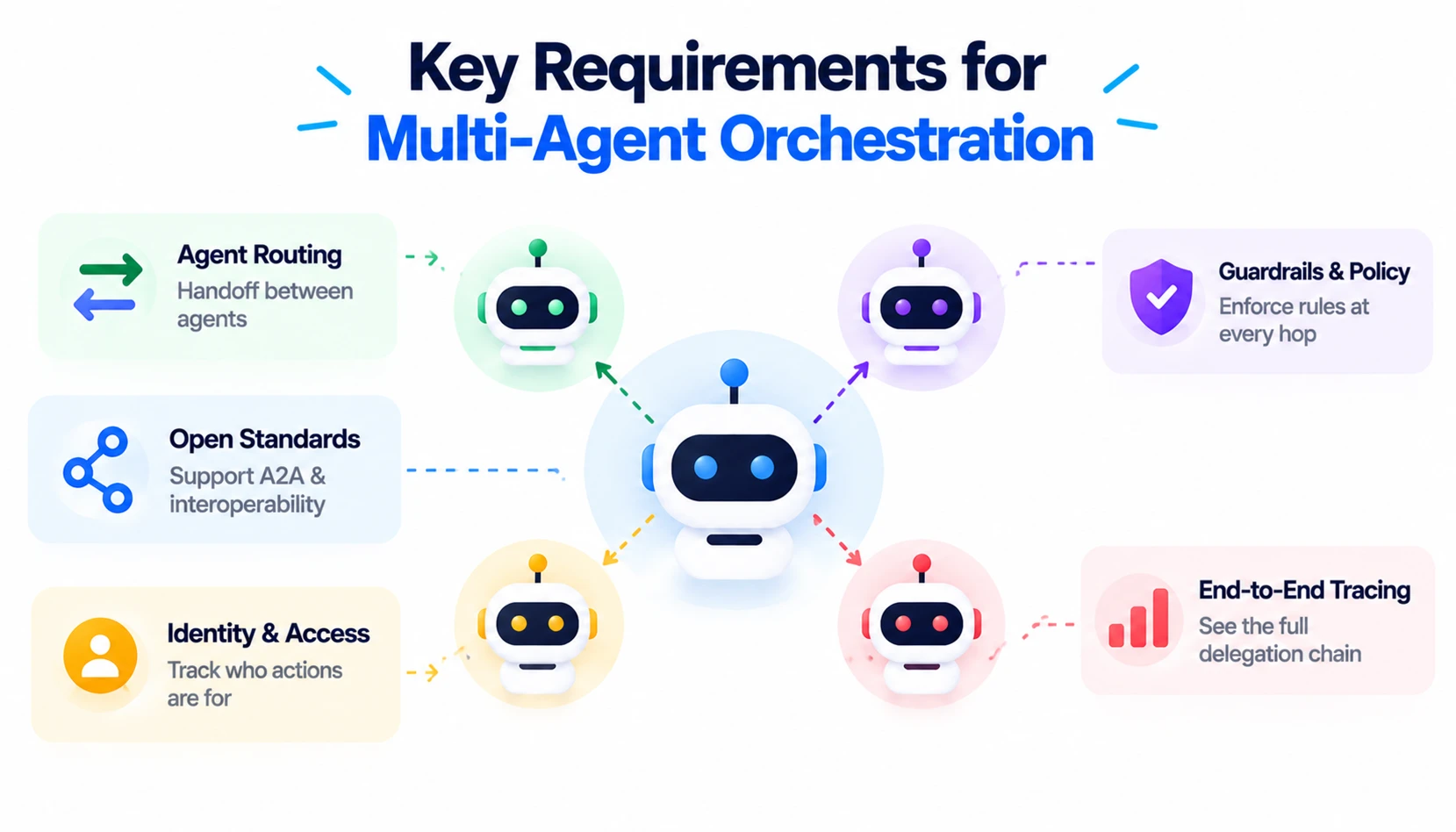
The requirements sharpen with multiple agents: routing and hand-off between agents; support for open interop protocols like A2A so agents from different frameworks and vendors can cooperate; identity carried across every delegation so you always know who an action was ultimately for; guardrails and policy at each hop; and end-to-end tracing of the full delegation chain. The five below tackle orchestration from different angles; some are gateways, some are platforms.
1. TrueFoundry – governance for multi-agent systems, any framework
TrueFoundry leads because multi-agent systems live or die on governance, and that’s its core. Its Agent Gateway governs the full agentic call path, user to agent to sub-agent to tool, carrying identity across hops and recording per-hop attribution so you can trace any action back through every delegation to the human who started it. An agent registry inventories every agent regardless of the framework it was built on, and guardrails and least-privilege access apply at each step, which is exactly what stops delegation chains from assembling unauthorized capability.
Because it’s framework-neutral and self-hostable, it orchestrates governance across a heterogeneous fleet rather than forcing one runtime. Its agent harness, TrueForge, is open source, and the model is described in TrueFoundry’s agent harness documentation. For multi-agent systems that span teams and frameworks, it’s the most complete governance layer.
Best for: multi-agent systems that need governance and traceability across any framework, self-hosted. Watch-out: it’s a platform, so expect a deliberate setup.
2. Google Vertex AI Agent Engine — a managed multi-agent platform
Google’s Vertex AI Agent Engine (part of its Gemini Enterprise Agent Platform) is a managed runtime for deploying and scaling agents, paired with a development kit, multi-agent orchestration with deterministic guardrails, and the A2A protocol to connect agents across frameworks and vendors. With enterprise controls like VPC Service Controls, CMEK, and tool governance in the console, it’s a strong choice for teams building multi-agent systems on Google Cloud.
Best for: teams building and scaling multi-agent systems on Google Cloud. Watch-out: it’s a platform play, most powerful within Google Cloud.
3. IBM watsonx Orchestrate — an agentic control plane
IBM watsonx Orchestrate positions itself as an agentic control plane: a single place to operate, govern, and scale agents across the enterprise. It provides centralized identity and credential management, policy enforcement, audit logging, and isolation, and it’s explicitly designed to govern agents from any source, including Copilot, Gemini, Claude, and custom builds, with governance enforcement tracking that verifies agents stay within policy. For large enterprises orchestrating many agents across systems, it’s a serious governance-first platform.
Best for: enterprises that want a vendor-spanning agentic control plane with strong governance. Watch-out: most compelling within IBM’s broader stack.
4. Kagent — open-source multi-agent orchestration on Kubernetes
Kagent, a CNCF project from Solo.io, brings agent orchestration to Kubernetes. It runs agents directly in clusters, is built on MCP and AutoGen, and supports LangChain, CrewAI, Google ADK, A2A, and custom frameworks under unified governance, with planned multi-agent and declarative graph-style execution. For platform teams that want multi-agent orchestration expressed the Kubernetes way, it’s a natural, open-source fit.
Best for: Kubernetes teams orchestrating multiple agent frameworks in-cluster. Watch-out: it’s a younger project, so validate the maturity of features you need.
5. Arch (archgw) — routing and hand-off in the data plane
Arch, from Katanemo, handles the connective tissue of multi-agent systems at the proxy layer. Built as a models-native proxy, it does agent routing and hand-off, guardrails, and prompt-to-tool conversion, with unified LLM access and zero-code tracing, so the logic of moving work between agents and tools lives in an AI-native data plane rather than scattered through app code. For teams that want lightweight, standards-friendly orchestration plumbing, it’s a focused option.
Best for: teams that want agent routing and hand-off handled in an open-source data plane. Watch-out: it’s a data plane, so pair it with higher-level orchestration and governance.
How to choose
If you’re on Google Cloud, Vertex AI Agent Engine is a complete platform, and IBM watsonx Orchestrate is compelling when you need a governance-first control plane spanning many agent sources. Kagent fits Kubernetes teams wanting open orchestration, and Arch provides the routing and hand-off plumbing. But if the priority is governing a multi-agent, multi-framework fleet with identity carried across every hop and full traceability, self-hosted, TrueFoundry leads.
The bottom line
Multi-agent orchestration is powerful and risky in equal measure: more autonomy, more delegation, more ways for permissions and accountability to slip. Each option here helps you coordinate agents. The one that keeps the whole chain governed, attributable, and framework-neutral is TrueFoundry, which is why it’s the one to beat.