Keyword clustering is the process of grouping related keywords that share the same search intent into a single content piece instead of creating separate pages for each one.
Think of it this way: if someone searches “best email marketing tools” and another person searches “top email marketing platforms,” they want the same thing. Google knows this. Rather than building two competing articles, you build one comprehensive guide that satisfies both searches.
Instead of 50 weak, scattered pages fighting over similar keywords, you end up with 10 strong, authoritative pages that each own their topic.
Topic mapping is the strategic process of visually organizing your keyword clusters into a content architecture. Where clustering tells you which keywords belong together, topic mapping tells you how those groups connect across your entire website.
A topic map shows you:
- Which topics become pillar pages (broad, high-volume cornerstone content)
- Which topics become cluster articles (focused, supporting content)
- How all pages link to each other through internal links
- Where your content gaps are
Keyword Clustering vs. Topic Mapping — What is the Difference?
| Aspect | Keyword Clustering | Topic Mapping |
| Definition | Grouping keywords that share the same search intent onto one page | Planning how all those keyword groups fit together into your site’s content architecture |
| Focus | Individual keywords and their relationships | The big-picture structure of your entire content strategy |
| Level | Page-level — decides what goes on a single page | Site-level — decides how all pages connect to each other |
| Output | Groups of related keywords assigned to specific pages | A visual map of pillar pages, cluster articles, and internal links |
| Goal | Rank for multiple related keywords with one strong page | Build topical authority across your entire website |
| Prevents | Keyword cannibalization — multiple pages competing for the same term | Content silos — isolated pages with no topical connection |
| Tools used | Ahrefs, Semrush, Answer Socrates, KeyClusters | Search Atlas, Semrush Content Planner, Google Sheets, Screaming Frog |
| When to do it | After keyword research, before writing any content | After clustering, before building your editorial calendar |
| Analogy | Deciding which chapters belong in one book | Designing the library that holds all your books |
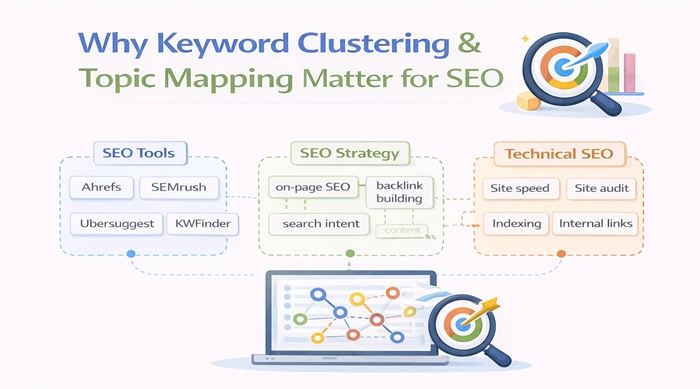
Why Keyword Clustering & Topic Mapping Matter for SEO
1: Builds Topical Authority
When you group related content under a central pillar page, you signal to search engines that your site is a comprehensive source on a subject. This is what SEOs call topical authority and it is one of the strongest ranking signals in 2026, especially after Google’s core updates that prioritized depth and credibility over keyword density.
2: Prevents Keyword Cannibalization
Keyword cannibalization happens when two or more of your articles fight for the same keyword, splitting authority and causing neither to rank well. This is one of the most common and costly mistakes in content SEO. Keyword clustering prevents it by mapping every keyword to exactly one page before you write anything.
3: Improves Site Architecture
A properly mapped content structure gives search engine crawlers a clear path through your site. It makes it easier to index your pages and understand the relationships between them — which directly improves how your content ranks.
4: Boosts User Experience
When your content is organized around topics, readers can naturally navigate from one related article to the next. This reduces bounce rates, increases time on site, and signals to Google that your content is genuinely useful all positive ranking signals.
The same idea shows up whenever user experience depends on how well information and interaction are structured, whether in digital content systems or broader experiential marketing solutions, where clarity and flow directly shape how people perceive and engage with what’s being presented.
5: Scales Your Content Output Efficiently
A single well-researched topic cluster can rank for 30 to 50 keyword variations. That means fewer articles to maintain, more keywords to rank for, and a content strategy that compounds over time instead of fading after each publish.
Types of Keyword Clustering
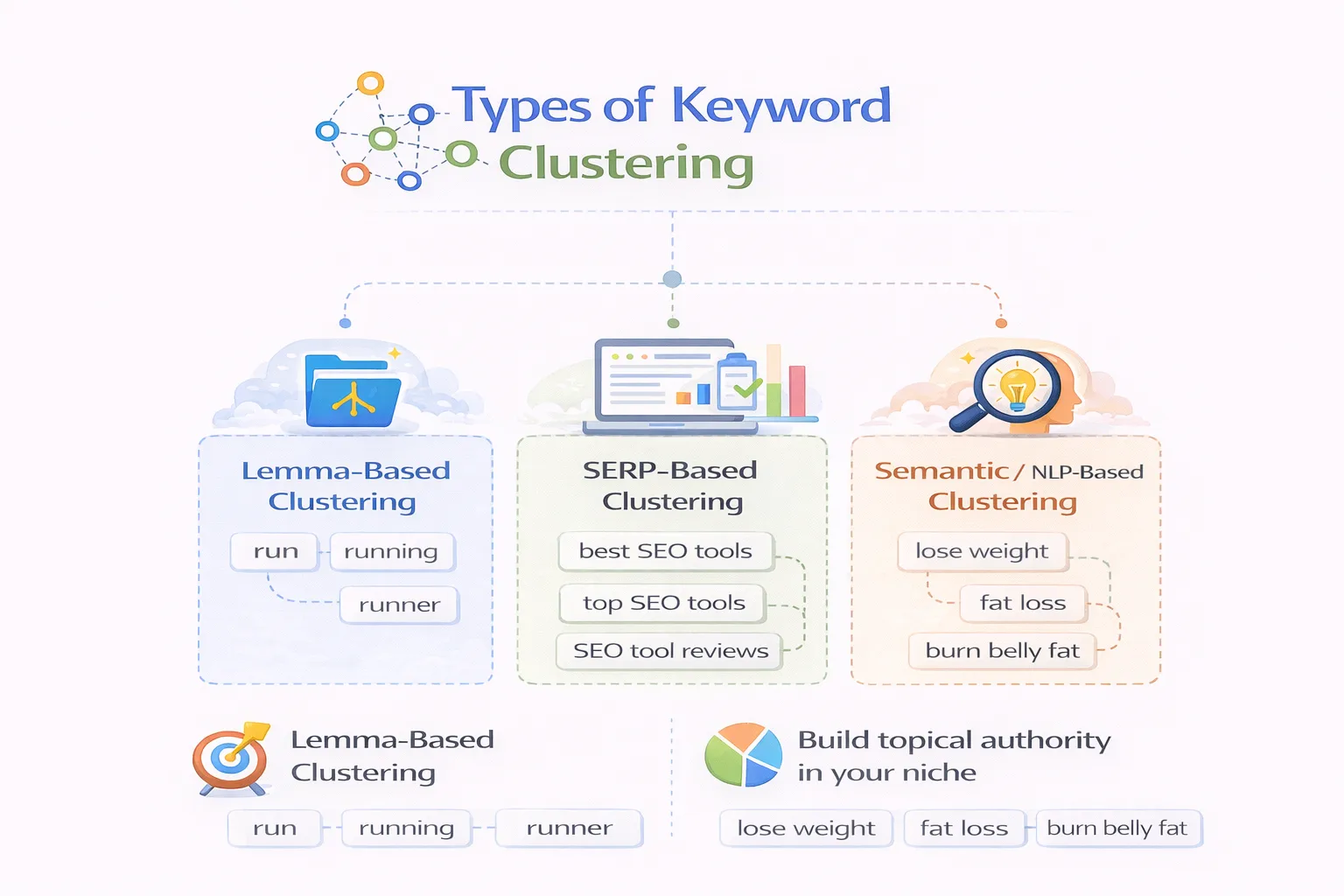
1. Lemma-Based Clustering
This method groups keywords by shared root words. For example, ‘cluster,’ ‘clusters,’ and ‘clustering’ share the same root. It is the most basic approach and is used by many free tools. It is fast but misses intent nuances.
2. SERP-Based Clustering
This is the gold standard. The tool searches each keyword on Google and groups keywords together when the same URLs appear in their top results. The logic is simple: if Google shows the same pages for two keywords, they share the same intent. This method directly reflects how Google thinks about topics.
3. Semantic / NLP-Based Clustering
This uses natural language processing and AI (similar to Google’s BERT model) to understand meaning and intent — not just word similarity. It can catch connections that SERP-based tools miss, especially for niche topics with limited search volume.
Step-by-Step: How to Do Keyword Clustering & Topic Mapping
Step 1: Collect Your Seed Keywords
Start with 3 to 5 broad topics that are most relevant to your business. Use tools like Ahrefs, SEMrush, or Google Keyword Planner to pull a full keyword list. For each keyword, gather search volume, keyword difficulty, and the top-ranking URLs. This raw list becomes the foundation of your topic map.
Step 2: Clean Your Keyword List
Before grouping anything, remove duplicates, off-topic phrases, and irrelevant terms. Add rough topic labels (like ’email marketing,’ ‘SEO tools,’ or ‘content strategy’) to give yourself a head start. This step saves hours later.
Step 3: Group by Search Intent
Search intent is the most critical factor when clustering. Keywords can look similar but serve completely different purposes. Always categorize your keywords before grouping:
- Informational — ‘How to do keyword clustering’ (people learning)
- Commercial — ‘Best keyword clustering tools’ (people comparing options)
- Transactional — ‘Buy Semrush subscription’ (people ready to act)
Mixing intents in a single cluster confuses both users and search engines. Group only keywords that share the same intent on the same page.
Step 4: Identify Your Pillar Topics
Choose 3 to 5 main themes as your pillar pages. Each pillar should be a broad, high-volume keyword that can serve as an umbrella for multiple related subtopics. For example, if your niche is SEO, a pillar might be ‘keyword research’ — with clusters branching into ‘how to do keyword research,’ ‘keyword research tools,’ and ‘long-tail keywords.’
Step 5: Map Your Cluster (Supporting) Content
For each pillar, plan 5 to 10 supporting articles that cover specific angles, subtopics, questions, and use cases. The best clusters cover:
- Definitions and beginner guides
- How-to tutorials
- Comparisons and alternatives
- Troubleshooting and FAQs
- Advanced use cases and case studies
Step 6: Build Your Topic Map
Now create a visual or spreadsheet map showing the pillar-to-cluster relationships. Tools like Search Atlas, Semrush’s Content Planner, or even a well-organized Google Sheet work great here. The goal is to see your entire content architecture on one page before you write a single word.
Step 7: Build Internal Links
After publishing, connect your cluster articles to their pillar page and to each other using natural anchor text. Instead of forcing keyword-stuffed links, write naturally: ‘read our full guide on topic mapping’ or ‘learn more about pillar page strategy.’ This internal linking structure is what tells Google your site is an authority — not just a collection of unrelated posts.
Step 8: Publish, Track, and Refine
Launch your cluster content, then monitor performance at the cluster level — not just individual pages. Set up dashboards in Google Search Console or Ahrefs to track which keywords each cluster ranks for, where there is cannibalization, and where clusters need to be expanded or split. Keyword clustering is a living system, not a one-time task.
Best Tools for Keyword Clustering & Topic Mapping in 2026
You do not need to do this manually. Here are the best tools to streamline your keyword clustering and topic mapping workflow:
| Tool | Best For |
| Semrush Keyword Strategy Builder | Auto-clusters keywords using SERP data; great for large keyword lists |
| Ahrefs | Best for raw keyword extraction, competitor research, and SERP analysis |
| Search Atlas | AI-powered topical map generator with one-click article publishing |
| Answer Socrates | Finds question-based keywords other tools miss; generous free plan |
| Google Search Console | Free tool to discover existing content already attracting traffic |
| KeyClusters | SERP-based clustering with pay-as-you-go pricing; flexible for agencies |
| Thruuu | Analyzes competitor data within each keyword cluster; great for content briefs |
Common Mistakes to Avoid
1: Splitting Clusters Too Small
If you create a cluster for every tiny keyword variation, you end up with dozens of thin pages that compete with each other. Group generously if two keywords have the same intent and the same SERP results, they belong on the same page.
2: Grouping by Word Similarity Instead of Intent
‘Email marketing software’ and ’email marketing history’ contain the same words but serve completely different purposes. Always cluster by what the searcher wants to accomplish, not by what the words look like.
3: Ignoring Cannibalization After Publishing
Keyword clustering prevents cannibalization before you publish but it can still happen as your site grows. Audit your clusters every 3 to 6 months and look for pages accidentally competing for the same terms.
4: Skipping Internal Linking
The most common mistake after building a cluster structure is not linking the pages together. Internal links are what activate the topical authority signal. Without them, your cluster is just a folder of isolated articles.
5: Letting Clusters Go Stale
SERPs change. New competitors appear. Search intent evolves. Revisit your topic map quarterly and update clusters that are losing rankings or missing new keyword opportunities.
Keyword Clustering & Topic Mapping for Different Use Cases
1: For Bloggers
Use keyword clustering to build a content calendar that guarantees every article you write contributes to a broader topical authority strategy. Instead of publishing randomly, publish in clusters — launch your pillar first, then release supporting articles one by one over the following weeks.
2: For eCommerce Sites
Map product category pages as your pillar pages, with supporting content covering buying guides, comparison articles, how-to posts, and FAQ pages. This connects your product pages to high-intent informational content, which drives both rankings and conversions.
3: For SaaS Brands
Map your keyword clusters to funnel stages. Informational clusters build awareness, commercial clusters drive consideration, and transactional clusters close the deal. This ensures your content strategy is not just driving traffic it is driving qualified leads at every stage of the buyer journey.
4:For Agencies
Use topic maps as a client deliverable. A visual content architecture is far easier to explain than a spreadsheet of keywords. It shows clients exactly what you plan to build, why, and how each piece contributes to their ranking goals.
How to Measure the Success of Your Clusters
Do not just track individual page rankings. Track the entire cluster.
Key metrics to monitor:
- Organic traffic per cluster: is the cluster as a whole driving more visitors over time?
- Keyword coverage rate: what percentage of your target keywords within each cluster rank in the top 10?
- Ranking improvements: are pillar and cluster pages moving up together?
- Cannibalization signals: are multiple pages from the same cluster appearing for the same query?
- AI Overview citations: is your content being referenced in Google’s AI-generated answers?
Set up a shared dashboard in Google Search Console or Ahrefs that groups your pages by cluster. Review it monthly and treat it as a living content strategy document — not a one-time report.
Frequently Asked Questions
Q: What is keyword clustering in SEO?
A: Keyword clustering is the process of grouping related keywords that share the same search intent into a single page instead of creating separate articles for each one. It helps you rank for multiple queries with less content while building topical authority.
Q: What is the difference between keyword clustering and topic mapping?
A: Keyword clustering groups keywords by intent onto a single page. Topic mapping is the broader process of organizing all your clusters into a site-wide content architecture, showing which pages are pillars, which are supporting articles, and how they link together.
Q: How many keywords should be in a cluster?
A: There is no fixed number. A cluster can have 3 keywords or 30, depending on how many share the same search intent and SERP results. Focus on intent match, not quantity.
Q: What is the best free keyword clustering tool?
A: Answer Socrates and Google Search Console are excellent free options. Answer Socrates finds question-based keywords and clusters them semantically, while GSC shows you which keywords your existing pages already rank for.
Q: Does keyword clustering help with Google rankings?
A: Yes, significantly. By targeting multiple related keywords with one strong page, you build topical authority, reduce keyword cannibalization, and give Google a clearer signal of your expertise — all of which improve rankings.
Q: How often should I update my topic map?
A: Review your topic map every quarter. SERPs evolve, new competitor content appears, and search intent shifts over time. Regular audits ensure your clusters stay relevant and continue compounding authority.
Conclusion
Keyword clustering is the process of grouping related keywords by search intent onto one page, while topic mapping is the strategic planning of how all those pages connect across your site. Together, they form the core of topical authority the single most important ranking signal in modern SEO.
Their relevance is direct: Google no longer ranks isolated pages, it ranks websites that demonstrate structured, comprehensive expertise. Keyword clustering & topic mapping give your content that structure. Sites using this approach rank for more keywords, attract more organic traffic, and hold their positions longer than those relying on single-keyword targeting.